Today is the 45th anniversary of an unusual experiment (this link takes you to a more detailed that article that I wrote about this for HistoryLink). On April 11, 1968, biologists working in cooperation with the Washington state Department of Game and the U.S. Bureau of Sport Fisheries and Wildlife collected 1,200 Canada goose eggs. Their goal was to use the eggs to build up the populations of these birds, which had been on a steady decline for years. They were successful, particularly so in the Puget Sound lowland, and they may be the source population for the thousands of Canada geese living year in the area now.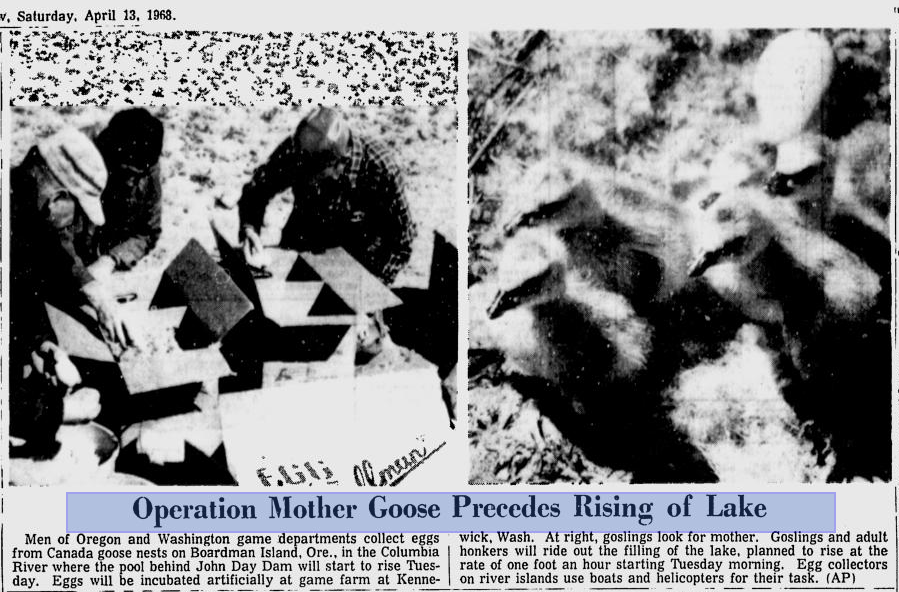
Operation Mother Goose, as the project was dubbed by Kennewick Game Farm Superintendent Curt Hedstrom, focused on collecting eggs on the Columbia River. The biologists knew that the eggs would soon be flooded out by the water rising by the nearly complete John Day Dam. After collecting the eggs, the men coddled them in goose down and put them in box, before flying them to Hedstrom’s game farm, which raised game birds for hunting. Most of the 1,200 eggs hatched and most of the young birds survived. Once the birds were old enough, the biologists planned to release them to wild flocks, where they hoped the youngsters would migrate with their elders.
More than 100 birds were released at two site, at the McNary Refuge and McNary Game Farm, near the confluence of the Snake and Columbia rivers. Other release sites include Arizona, Spokane, and the Couer D’Alene River, in Idaho. By mid-June, the biologists had transplanted more than 900 goslings. The releases were front page news for days.
But what these stories failed to report is that Operation Mother Goose youngsters most likely were released in the Seattle area. The record is not completely clear though biologists I talked with who were involved said that some were most release west of the Cascades. Hedstrom said that he thought that some were planted near Lake Washington, though he had no details. This would have been done to establish a population for hunters.
We cannot know if our modern geese are descendants of these original birds, or even if they really were released around Seattle. Canada geese would probably have eventually colonized this region. Historically they did not inhabit the forested west because they do not like this habitat but urban landscapes are goose heaven: no predators, lots of shoreline, and lots of wide open territory with a good food source, grass. And, of course, many people also feed them.
Many people though do not like the birds. They don’t like their poop. They believe the birds spread disease and are too aggressive. In response, thousands of Canada geese have been rounded up and killed. As I have written before, I am troubled by this response, that the solution to an animal problem is to kill them, and this for an animal whose main fault is pooping too much. This paradigm is one we have used far too many times before and what that we are now using again with wolves in eastern Washington.
When will we learn that we do not live in isolation, separate from the natural world around us. Too often we look for someone else to blame without looking at our actions. Regarding geese, we can make our urban habitat less friendly to the birds. We can be a bit more tolerant. The geese can be somewhat problematic but perhaps we can look for other solutions.