My wife and I bought our house for a simple reason: the massive Douglas firs in the backyards. We had been looking at houses for about two months when we came across the tree-rich yard and the nondescript house. We knew immediately that this was the place. Where else would be find such trees, the biggest of which we couldn’t put our arms around? Now, nearly 15 years later, we know that we made the right decision.
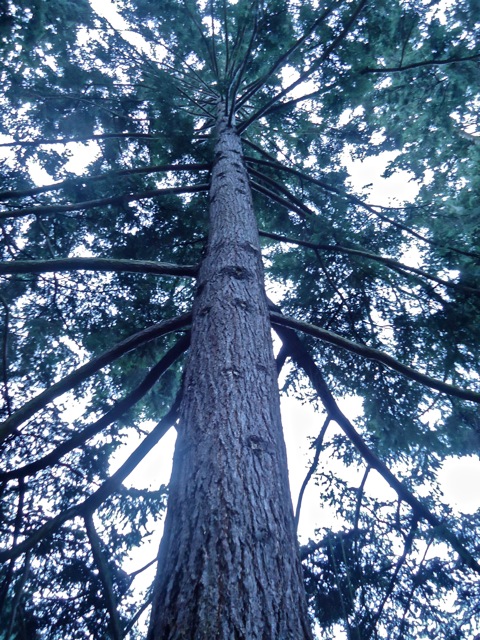 Recently, I have been reminded of our correct choice. For the past couple of weeks, an adult and an immature bald eagle have regularly visited our trees. My first not-so-subtle hint was an adult eagle flying about 30 feet over our heads in our front yard. The bird then turned abruptly and landed in a Douglas fir in our neighbors. And then every few mornings, at about 6:30, I heard two eagles calling in our back yard.
An eagle’s call is surprisingly squeaky, sort of a higher pitched call of a gull. The calls make me think of two pieces of hardwood being screwed together. In my mind, I see a wooden bolt being threaded into a wooden opening. (You can hear it at the the Cornell Lab of Ornithology site; just play the recording for typical voice.) The sound is not what I expected. For some reason, I figured that our national symbol should have a more majestic call. I guess I was being a typical citizen of the USA thinking that if it stands for our country, it must be mighty. Oh well, wrong again. Still the bald eagle’s unctuous call is a pretty cool sound to hear as a wake up alarm.
But eagles are not the only exciting animal in our big Doug firs. I often find owl pellets at the base of the trees; I have heard an owl but have never seen who coughs up the boluses of fur, bone, and feather. In contrast, I have seen Coopers hawks sitting on the trees’ branches ripping apart unidentified birds. My wife and I once saw three of the hawks sitting in the trees. And, then there are the less sexy but equally intriguing avian visitors, such as red-breasted nuthatches, red-breasted sapsuckers, varied thrushes, and brown creepers. This doesn’t include the two mallards that I saw one day paddling around the top of our garage, which regularly floods. The garage is directly under the firs so I decided that I can connect the ducks to the Dougs.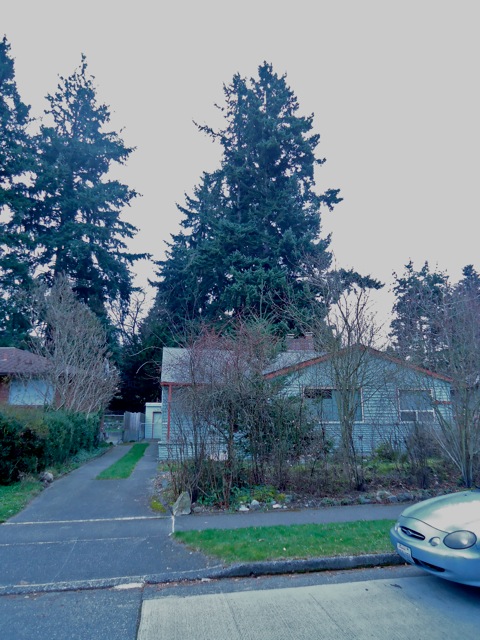
We in Seattle are fortunate that we have so many big native trees in the urban environment. Seeing the effects of having Douglas firs in our backyard reiterates why we need to protect as many of them as we can. And not just tall native trees but big trees of any kind, even if they do block the views of retired baseball players. The trees are essential as habitat for a wide array of life, and a wonderful asset for an urban naturalist.
(This piece originally appeared at the Seattle P-I Urban Naturalist Reader’s Blog.)