Greystones: Chicago’s Answer to Brownstones

Many people, including me, have written extensively about the classic brownstones of New York and Boston. Recently, I learned about a similar building style popular only in Chicago. Architects and historians call the buildings greystones. The term refers to structures built primarily between 1890 and 1915 and most often in the Chicago neighborhood of North Lawndale. A survey published in December 2005 for the Historic Chicago Greystone Initiative estimated 1,714 greystone buildings in North Lawndale.

North Lawndale has an incredibly rich social history. By 1930, only Warsaw and New York had more Jewish residents. Forty nine synagogues dotted the neighborhood. By 1960, however, African-Americans made up 91 percent of the population. As Charles Leeks of Neighborhood Housing Services of Chicago wrote in The Chicago Greystone in Historic North Lawndale “If Lawndale’s Greystones could talk, they would tell us” of Golda Meir, Dinah Washington, Benny Goodman, Martin Luther King, Jr., and Clarence Darrow making a vibrant, dynamic neighborhood.

From: www.nhschicago.org/content/greystone.php

Like the brownstones of the east coast, Chicago’s greystones were two- or three-story, commonly 2 or 3 flats (though there could be up to 6), flat roofed, brick buildings with a façade of more fancy stone. There also were greystone mansions and one-story greystone “shoeboxes,” but not so many as to define a unified style. More then 93 percent have fewer than five residential units. Working class people of modest means, with some more affluent middle class folks, were the primary buyers and tenants. Some streets are entirely greystones flats, whereas others may contain just one or two greystones.

On the eastern seaboard, the stone embellishment was the 200-million-year old Portland Formation. Chicago builders, in contrast, took advantage of their proximity to the great limestone quarry region of Indiana and enhanced their brick with the 330-million-year old Salem Limestone. I won’t write more about these stones because I have covered them thoroughly in previous blog posts.

The survey found two stages of style. Initially between 1890 and 1905, primarily Romanesque buildings with rusticated limestone dominated. They featured arches and robust cornices. Next came a Neo-Classical look incorporating smooth limestone blocks, bay and Palladian windows, and columns. Throughout the era, many builders also built purely brick buildings in the same styles. Curiously the color of the brick changed from red to tawny.


From: www.greystonepreservationllc.com

Beginning in 2006, a consortium of groups banded together to form the Historic Chicago Greystone Initiative to preserve these wonderful buildings. Composed of community residents, non-profits, business, academic, and government partners, the Initiative promotes renovation and protection, through technical and financial assistance. They are doing vital and critical work. I wish them continued success.

Marble Madness and Mayhem

Several weeks ago I received an interesting email from a Danish engineer in regard to my story about the Aon/Amoco/Standard Oil building (Big Stan) in Chicago. He was concerned that I had given a jaundiced picture of marble as a cladding material. “You forgot to write that there are a very, very high number of marble facades performing extremely well in all kinds of climatic zones,” he wrote. He is absolutely correct that the vast majority of buildings clad in marble do not experience the panel bowing problems found on Big Stan. Marble is generally a sound choice, when used correctly.

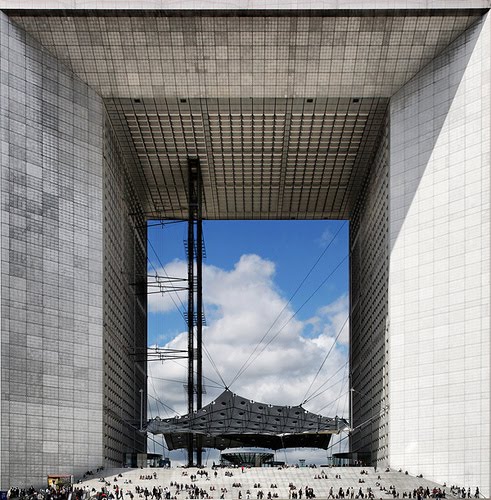
But in the article co-written by my Danish correspondent, it is also clear that there have been what seems to me an unusually high number of buildings where marble cladding has failed. (Durability of Marble Cladding—A Comprehensive Literature Review, in Journal of ASTM International, v. 4 no. 4, 2007) These include La Grande Arch de la Defénce (see photo below) and SCOR Tower, Paris; Richmond City Hall, Virginia (all marbles panels removed and replaced by steel, painted aluminum, and granite); and IBM Tower in Brussels.

Two buildings stand out for the most notorious warping. One is the 310-foot tall Zagrepcanka tower in Zagreb, Croatia, unaffectionately dubbed “The hells tower,” due to falling panels that led to construction of a tunnel to allow employees to reach the entrance. (The smaller photos are of the Zagreb tower, by Jan Anders Brundin.)
The other is Helsinki’s Finlandia Hall, designed by the great architect Alvar Aalto. Completed in 1972 with 7,000 square meters of Carrara marble, the panels started to deteriorate with bowing, cracking, and spalling. The fine citizens of Helsinki decided to replace the panels and chose to reuse Carrara again. Within six months these new, supposedly ultrastrong, ultrasecure panels began to warp. Curiously, they warped convexly; the original panels warped concavely. To this day no can explain why.
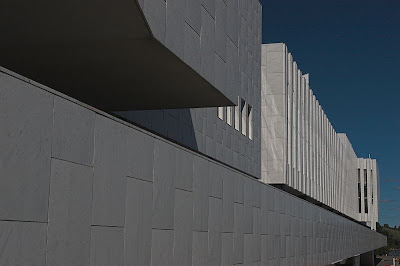

Finlandia Hall in Helsinki, with Carrara marble panels, image from Wikipedia

Building stone has failed across climates from northern Europe to Cuba to Libya to Canada in marble quarried in areas equally as diverse, such as Vermont, Greece, Greenland, and Norway. Carrara marble, however, leads the field, in part because it is the most widely used marble in the world.

In their report, the authors made several observations:

  1. The higher the temperature variations, the higher degree of bowing.
  2. Higher humidity can lead to problems when water penetrates pore spaces.
  3. There is no correlation between panel size and thickness and tendency to bow.
  4. Bowing tends to be more pronounced on the southeast and southwest facades.
  5. More pronounced bowing occurs on the upper parts of buildings.
  6. No link has been found between anchoring system and bowing.
  7. Marble color doesn’t impact bowing.
  8. Pollution doesn’t impact bowing.
  9. At least a half-dozen previous authors have noted that bowing depends on the grain boundaries of the marble, which ultimately depends on the geologic history of the stone.

The authors recommend the development of a series of guidelines to choose, test, and produce marble panels. They conclude that “technically acceptable properties should…have very high priority when choosing a marble type for a building project, whereas today aesthetical properties are often considered as being of greatest importance even though the aesthetic problems will change rapidly for a nonsuitable marble as it deteriorates.” In other words, no matter how pretty and elegant the Carrra marble looked on Big Stan, when they failed, it was a monumental screw up that could have been avoided if the builders had been more concerned with function over style. Once again, it pays to pay attention to geology.