Michelangelo carved David 500 years ago and he still looks good. Nineteen years after Standard Oil clad their Chicago headquarters in the same stone, Carrara marble, the company had to replace all 44,406 panels on the 80-story building, the world’s tallest marble-clad structure. Engineers and architects hadn’t accounted for the extremes of Chicago weather, which had warped the panels, some up to one and one-half inches. The error in choice of stone cost the geologist-rich, oil giant between $70 – $80 million, more than half the original cost of the building.
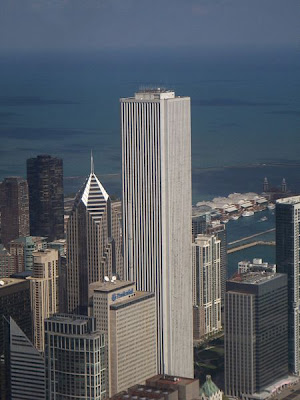
The Aon Center, formerly known as Big Stan then Big Amy (from Wikipedia)
Big Stan, as wags dubbed it, was the apogee of Carrara marble construction. First quarried in the middle 1st century BCE, Carrara was the marble that allowed Augustus to make his famous boast of finding Rome a brick city and leaving it a marble one.
Augustus may have exploited it as a building stone but Michelangelo was the person who bestowed grace on Carrara marble. Michelangelo first used Carrara for his Pietà, which he followed three years later with David. Completed in 1504, David sealed Michelangelo’s reputation as the greatest sculptor and Carrara’s as the most ethereal and eternal stone. What better way than to illustrate the permanence and prominence of a titan of business, particularly one dedicated to a geologic pursuit, than to erect a 1,136-foot-tall tower of marble? Designed by Edward Durell Stone, Big Stan was begun in 1970 and completed in 1972.
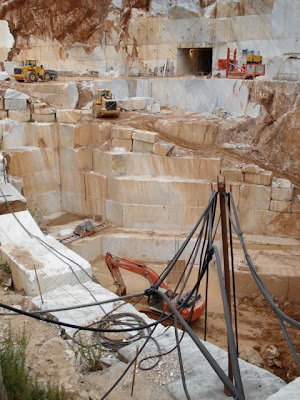
Quarrying in modern Carrara
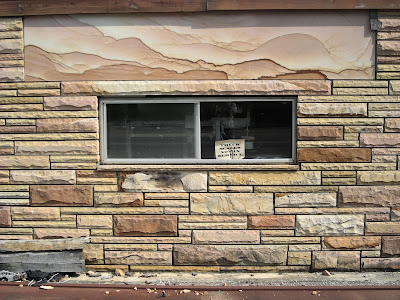
Panel problems appeared within a few years. By 1979, over 2,000 panels had cracks and bowing. Before replacement, 31 percent of all panels arched at least 1/2 inch. Standard Oil (now known as Amoco) considered seven options before deciding to replace every panel with a white granite quarried in Mount Airy, North Carolina. Recladding occurred between 1988 to 1992.
Geologists traced panel failure to two factors, both related to the marble’s geologic history. Carrara is nearly pure calcite, a fact much ballyhooed by Carraraphiles because it makes the marble brilliantly white and excellent for carving, but which weakens the marble because of how calcite responds to temperature change. When heated, calcite expands and contracts differently along different internal axes and, when cooled, it cannot return to its original shape because the crystals interfinger with each other. With growth in one direction and contraction in another, failure was inevitable.
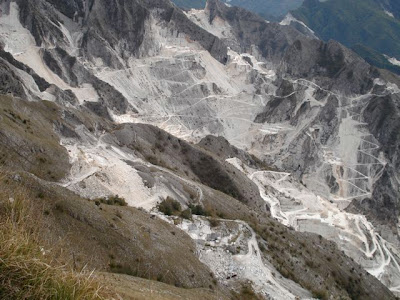
Quarrying is a very, very big business in Carrara
Carrara’s purity results from the first stage of its formation, 200 million years ago in a shallow, warm sea, just north of the equator at the eastern edge of the supercontinent of Pangaea. Numerous invertebrates as well as algae and single-celled critters called foraminfera generated huge volumes of calcite, which accumulated as skeletal fragments, mud, and spherical grains and later solidified into a homogeneous limestone.
The limestone metamorphosed into a marble 27 million years ago when a small tectonic plate rammed into Italy and shoved a suite of rocks into a layered stack, which included a 200-million-year old limestone. The weight of the rocks generated heat and slowly began to bake the limestone and convert it to the Carrara marble.
Metamorphism created the second problem for the Amoco Carrara panels by aligning minerals. After temperature changes weakened the marble, it became susceptible to a release of stress, which had been generated by the overlying sediments aligning minerals and grains. (Stress release has long been known at Carrara quarries, occasionally leading to rocks exploding on trucks several days after they have been cut.) Weakened panels were further sapped of strength by water, which expanded during freeze/thaw cycles.
After removing the panels, which weighed over 6,000 tons, Amoco ground up most it for landscaping at the Amoco refinery in Whiting. A final 500 tons was made into clocks, awards, and trinkets and sold at its granite-clad headquarters for between $150 and $250. (If anyone has photos or owns these trinkets, it would be great to see photo of one.) It’s a good thing Michelangelo has been dead for nearly 500 years or else he would be spinning in his grave.