StoneFest: The Stone Masters

As someone seriously interested in rocks for the past 25 years or so and building stone for the past dozen, I am embarrassingly bereft in my practical knowledge of pounding rock. Yes, I have whacked rock on many an outcrop (and, of course, played numerous rounds of rock hammer golf), but never had I hammered rock with the goal of creating a shape, such as a letter or block, or even watched someone else hammer rock, until StoneFest. As I stated in my previous post, it was a revelation.

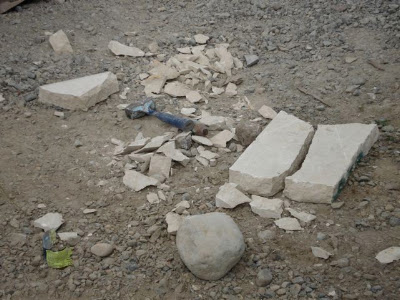
Stone and hammer: some of life’s simpler pleasures.

The master stonemasons were a joy to watch. Each time their hammer or mallet struck the chisel, it was done with confidence. The confidence manifest itself in three ways. First, was in having the right tool. Second, was in locating the chisel at the right point to take off the precise piece they needed, and third, was to hit with the right amount of pressure. They were the masters of the rock. But they also knew that stone could be capricious and they did make errors.

Keith Phillips showing the various textures one could apply to stone with a hammer and chisel.

I especially enjoyed watching Keith Phillips, who is the master stone cutter at the Tenino Sandstone quarry, 20 miles or so south of Olympia, Washington; and Nathan Blackwell, 87 years old and still making his own tools and cutting stone. They helped one of the students cut an S-shaped curve called an ogee. Nathan was particularly impressive, getting into a hitting rhythm as he trimmed along the curve, took off surface rock, and began to cut out the shape. It was if the tools were extensions of his hands. Within minutes the block had metamorphosed from a rock to an arch.
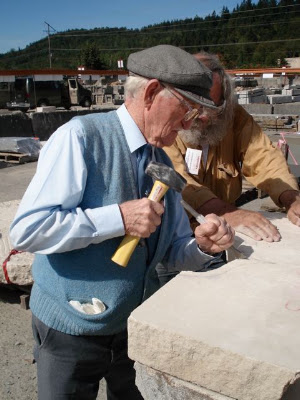
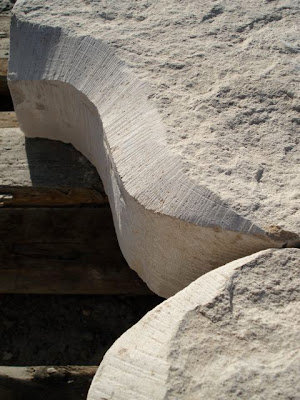
Nathan Blackwell at work. An exemplary gentleman who always wears a tie when cutting stone.

Robinson Jeffers once compared stone cutters to poets. Each works precisely, deliberately, and considerably to fashion their particular work of art. He wrote in his poem To the Stone-Cutters:

“Yet stones have stood for a thousand years, and pained thoughts
found
The honey of peace in old poems.”

The final product: an ogee arch cut with a hammer and chisel, the marks of which give the arch its texture.

Keith Phillips said “Oh, some people say, it’s just stone but we are trained to be accurate, to build a building that will last 100 years.” Keith’s comments gets to the heart of the passion I felt at StoneFest. These were people dedicated to making high quality and often beautiful products that would endure. In our modern age of prefabrication and machine made items often put together half way around the world, it was a treat to watch these people work with tools that had basically remained unchanged for centuries. I know that I forget the amazing items that talented people can produce. It was both a revelation and a reaffirmation of the human spirit.

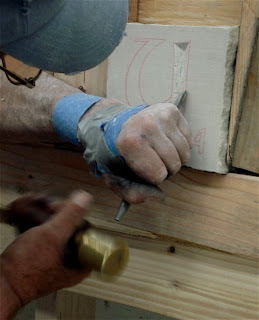
Scrubble: Carving the Big Tiles

Over the past few days I participated in a wonderful event called StoneFest. The four-day extravaganza brought together stonemasons, sculptors, and letter carvers to share their love for stone. My next few blog posts will focus on what I learned and saw. It was an eye opening experience as I have never worked with stone except to whack off pieces in the field.

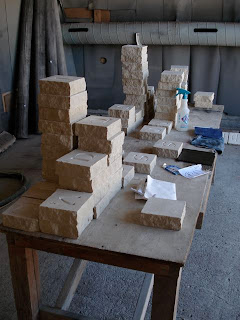
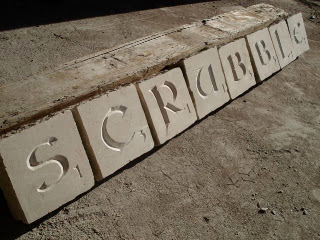
Being both a lover of words and rock, my highlight of this year’s StoneFest was the creation of a huge scrabble board, dubbed the Scrubble board by its designer, master letterer Karin Sprague. Each of the 100 tiles was made from a six inch by six inch by two inch block of limestone. The board was a piece of canvas painted to resemble the regular game. It measured about eight feet by eight feet.

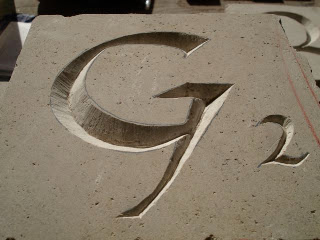
Not content with the simple lettering of the normal-sized version, Karin used a 3rd century Celtic font in what is known as the Uncial style. She then scaled her hand written font up to fit the blocks and traced each letter in red pencil onto the flat face of the tiles. Karin, as well as many of the participants at StoneFest carved each of the tiles. I was surprised how easily we were able to cut the letters.

I don’t mean to belittle what we did; the process went quickly because Karin was a good and patient instructor and because many of those who worked on the letters had extensive experience with stone. We also benefited from the soft, easy-to-cut limestone, as well as the high quality tools we used. It was revelation to me to see how skilled artisans shaped stone, especially the masters who cut with such confidence. You could easily see that every time they hit the chisel with the hammer, the chisel went exactly where it was supposed to go.

After completing our task, we played a round of Scrubble at our celebratory StoneFest feast. About 20 to 25 of us participated. We didn’t keep track of points. We all had fun and I think we all got a good workout hefting the heavy tiles around.