The Clam That Changed the World – Chapter 5

Hardly anyone thinks that clams changed the world. Most are benign, industrious critters toiling away in the sand or resting quietly in the sea. If we do consider them, it’s mostly because many are edible and some produce valuable, nacre-coated irritants worn as fashion. Perhaps the most famous bivalve in the world is the one that supports Venus in Botticelli’s legendary painting, The Birth of Venus. Botticelli depicts the Roman Goddess of beauty and love using the shell as a mode of transport as she arrives on land, blown by the winds. Although unrealistic as a way to travel, Botticelli’s shell does fit the classic image of a bivalve, something trod under foot.

Castillo de San Marcos, courtesy of National Park Service

Thus some find it odd that a bivalve, in particular a much smaller clam than the one that carried the lovely Venus, was seminal to the early history of colonization of North America. Carolina governor James Moore was the first to discover the power of the clam when he lay siege to the Spanish town of St. Augustine, Florida, in 1702. Moore attacked St. Augustine with 800 men, which forced all of the town’s residents into their recently completed fort, known as Castillo de San Marcos.

For six weeks, Moore bombarded the Castillo, but with no luck. Cannonballs either bounced off of or stuck in the fort without breaking the walls. What was the miraculous building material? It was an unusual variety of limestone called coquina (Spanish for “little shell”), which outcrops along the northern Florida coast. It formed 110,000 years ago as billions of bivalves accumulated on beaches. By far the most abundant bivalve is the coquina clam, Donax variabilis, the clam that changed the world.
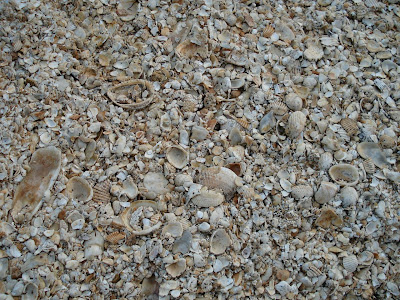
Moore eventually abandoned his nefarious plans and retreated back to Carolina. Thirty years later the English tried once more to take St. Augustine. Again they failed because of the coquina, leading one British soldier to express “[it] will not splinter but will give way to a cannon ball as though you would stick a knife into cheese.” Without the clam, one can argue that the English would have succeeded in invading St. Augustine, driven the Spanish out of Florida, and who knows how the world would have turned out.

But because of the clam, no armed force ever took St. Augustine. The Castillo still stands, a wonderful tribute to the power of stone to influence architecture, history, and politics.

Earmarks and geology

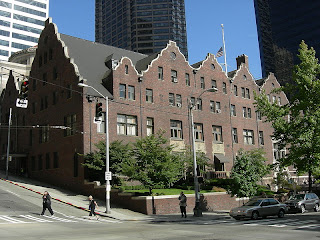
There has been a big stink of late in Seattle about a proposal by our congressional representative, Jim McDermott, to obtain $250,000 for a tony social club in the city. Seems that The Rainier Club is having issues with some of its windows and wants to rehab them. Unfortunately, the club’s members have been willing to pony up only half the cash for repair work. This is where McDermott has stepped in. He included money for the club as part of a number of requests he made to the House Appropriations Committee.
Rainier Club from Wikipedia
Since the local paper reported the story, readers have expressed much indignation. How could such a club, long a haven restricted to men only, get money in such dire times?

I don’t want to comment exclusively on the request, but would like to point out something that no one has noted – the repair work would be for window sills made of Salem Limestone. The builders of the Club’s home used the 330-million- year old Indiana rock as a contrast to the main building material, brick, both inside and outside. Of particular note is the low exterior wall next to the sidewalk, a place I often stop on my building stone tours because of its excellent display of fossils. These include bryozoans, crinoids, and brachiopods. Ironically, quarry workers in Indiana consider this fossiliferous stone to be of inferior quality, mostly because it is less homogeneous than other layers of the Salem.

I think that providing money for the Rainier Club is rather absurd but I am loath to completely criticize McDermott. I can certainly think of worse ways to spend our federal money than on Salem Limestone.