Today, I learned about another great stone tombstone. It is a several-foot-tall piece of petrified wood that marks the grave of one of my heroes, Alfred Russel Wallace. Wallace, who came up with his theory of natural selection while in a malarial haze, was buried at the Broadstone Cemetery in the town of Broadstone, about 100 miles southwest of London. He died on November 7, 1913, and despite some suggestions that he be buried next to Charles Darwin at Westminster Abbey, Wallace had a simple burial on November 10.
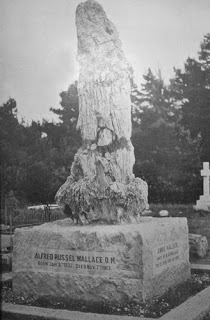


Three images of Wallace tombstone: From 1914, from 1999 (before restoration), from 2001 (after restoration). Oldest image is from James Marchant’s book, Alfred Russel Wallace; Letters and Reminiscences. Modern shots both by George Beccaloni from his web site devoted to Wallace. Copyright of 1999 and 2001 images owned by George Beccaloni
His grave marker consists of a block of Purbeck limestone, often incorrectly called a marble because of its abilty to take a high polish, on which stands the petrified wood. According to a web site devoted to Wallace, the tree could have come from the Isle of Portland, which Wallace visited in 1894 with the famed American paleobotanist Lester F. Ward. The petrified wood on Wallace’s grave resembles a tree identified as Protocupressinoxylon purbeckensis, a conifer. These trees grew near a hypersaline lagoon in a Mediterranean-type climate of warm, wet winters, and hot, dry summers. The trees, many of which have been found upright, in situ, occur in the Great Dirt Bed of the Purbeck Formation. Deposition was around 146 million years ago.
In 1998, George Beccaloni, an entomologist at the Natural History Museum in London, visited Wallace’s grave and was surprised to find it in horrible shape. A tree engulfed the site and made it nearly impossible to see the plaque that mentioned Wallace. In addition the tree’s roots were pushing up the old marker. So in 1999, Beccaloni established the A. R. Wallace Memorial Fund to repair and restore Wallace’s grave.
With funding provided by a number of sources, Wallace’s site has now been restored and enhanced. The Fund added a granite block under the Purbeck limestone, to prevent further root encroachment, and placed a new plaque on the grave, which provides a few key details about Wallace’s life, including his contribution to evolution by natural selection. It is suitable way to honor one of the greats of natural history.


