Brownstone Tombstones

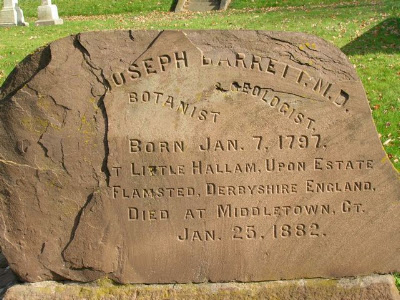
Continuing my theme of tombstones, I would like to turn to a singular grave marker in Middletown, Connecticut, just across the border from the old brownstone quarries in Portland. I believe this may be the only tombstone with dinosaur tracks on it. It honors Joseph Barrett, an M.D., though judging from the stone, he was equally as proud to be a botanist and geologist. Who wouldn’t?
Barrett was well known in the area for his passion for tracks. His obituary in the New York Times read “So deeply was he engaged in this work that he neglected his profession and became a monomaniac on the subject of bird tracks. He saw all manner of fossils in city walks which no other eyes were able to see, and in his peregrinations about the town would stop suddenly, look at a stone, bring out a sheet of wrapping paper and, laying it out on the walk, draw upon it whatever his fancy painted, write the place where the stone lay and date its discovery.” Oh, to be able to see those drawings!

Barrett also regularly supplied tracks to Edward Hitchcock, who taught at Amherst College and is considered the father of ichnology. Hitchcock never could admit that dinosaurs made the tracks; birds were the track makers.
When Barrett died, according to brownstone historian Alison Guinness, the local quarries donated two slabs of stone. You can find the facts on the smooth face. You can also see how brownstone weathers, peeling off layer by layer like sunburned skin. The back side, though, is the face to explore. Several three-toed tracks can be seen crossing at angles to each other. The most obvious one is just to the left of center, next to a round white lichen. Another one is a few inches down and to left. They have been designated as Grallator formosus and Brontozoum sillimanicum.
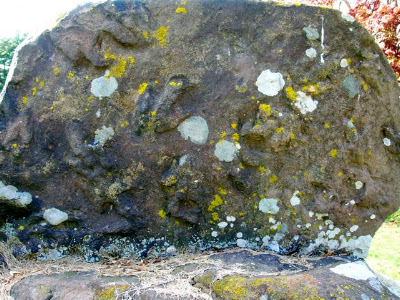
The back side of Barrett’s tombstone. Note the various tracks of three-toed dinosaurs.
The second slab, which the first sits on, has two tree casts. In addition, you can see where it says “The Testimony of the Rocks.” This book, written by Scottish geologist Hugh Miller and published the year after his death in 1857, is a curious combination of anti-evolution but supportive of a great age for the Earth.

Together these two slabs are certainly a wonderful tombstone testimony to the passion of a man for the stone and the fossils he loved.

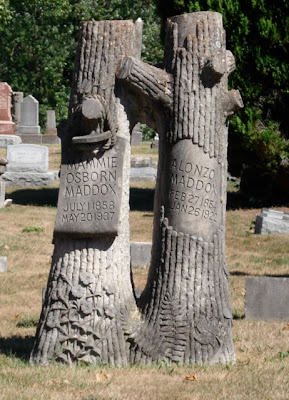
Tree Stump Tombstones

As noted in my previous posting, slate does have a long history as a wonderful tombstone material but my favorite tombstones are the ones carved from Salem Limestone. At Green Hill Cemetery in Bedford, Indian, a pair of six-foot-tall tree stumps with interlocked broken branches memorializes Mammie Osborn Maddox and Alonzo Maddox. Stone flowers “sprout” from the base of her tree with ferns “growing” from the base of his. Nearby stands the tombstone of Hattie Wease, who died in 1912. Her tree stump rises from a stack of horizontal, cut logs. Above her name are an axe and mallet, carved with precise detail into the stone.

Other stumps depict vines climbing the bark, a lamb at the base of a child’s tomb, doves nesting on branches, or frogs hiding in foliage. Not purely decoration, each design has symbolic meaning. A broken branch represents a life cut short. A frog alludes to resurrection. Doves symbolize peace. These are shibboleths, codes that united individuals to a larger community. Even in death the residents of limestone country looked to stone to forge a common bond.

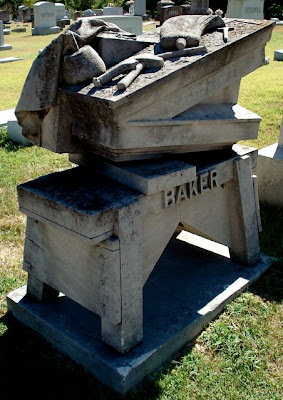
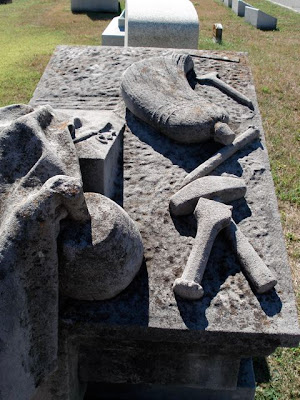
My favorite carving of all though honors Louis Baker, a 23-year old stonemason, who died in April 1917, when lightning struck him at home. His co-workers sculpted an exact replica of how Baker left his work bench. On the upper edge of a slanted stone slab, they carved his metal square. Below rest a narrow drove and a stub-handled broom, one edge of which abuts a foot-long point. A wider chisel leans atop a hammer that just touches the sharpened end of the point. Nearby is the apron he tossed onto his mallet. The slab sits on another slab, propped on a bench so perfect in detail of the wood that one of the “boards” warps and others have cracks where someone, perhaps the young stonemason, had overtightened the bolts holding together the planks.

The bench moved me not only because it reveals the qualities of stone—90 years of weathering have not removed the details of individual straws of the broom, but the bench also reveals the qualities of the men who worked the stone. Yes, they could carve elaborate and beautiful pieces, but to honor one of their own the men of limestone country produced a monument that reflected gratification in working with simple tools, pride in their trade, respect for their co-workers. Neither fancy nor symbolic, Baker’s tombstone is utilitarian and straightforward, qualities that made Salem Limestone America’s building stone.