The Most Beautiful Building Stone in the Country

My favorite liquor store in the country is in Morton, Minnesota. It’s an odd sort of store, mostly bar, with a small section up front where one can buy bottles. I, of course, don’t like it for its alcohol selection, but for its architecture, or more particularly its cladding. I am guessing but feel confident that no other liquor store in the country, perhaps in the world, is built with older stone. The rock that covers the liquor store is the 3.5-billion-year old Morton Gneiss, what one geologist calls “the most beautiful building stone in the country.”

Rectangular, two stories tall, and clad partially in brick, the Morton liquor store has a practical appearance, though it does incorporate some semblance of an aesthetic with the cornice and frieze. They have a pattern of outlined squares atop two, horizontal rows of raised bricks, which rest on another row of inverted, stepped pyramids. A faded red awning adds another touch of character, boldly proclaiming in large white letters, MORTON LIQUOR.

The gneiss starts below the cornice. Pink and black layers swirl around each other as if they are still fluid. Other layers look stretched and torn like taffy. Four inch-wide eyes of black minerals, complete with white eyebrows, dot the variegated layers. I cannot imagine trying to contemplate this wall of stone after spending a few hours partaking of the goods sold within.

Known in the trade as Rainbow Granite, the stone has been quarried in Morton since 1884. Cold Spring Granite has longed owned the quarry, which is opened on a limited basis. Because of the stone’s unusual color and patterns, it was a popular building material during the 1920s and 1930s, when Art Deco architecture was all the rage.

The Qwest Building in Minneapolis, originally the Northwestern Bell Telephone Building, built 1930-1932

Morton clad structures can be found around the country. The tallest is in New York, the 952-foot high AIG building (formerly Cities Service). The most northern is in Seattle, the Seattle Exchange Building. The closest to John Wayne’s birthplace in Winterset, Iowa, is in Des Moines, the Bankers Life Insurance Building. The most recently converted to lofts is in Birmingham, Alabama, the Watts Building.
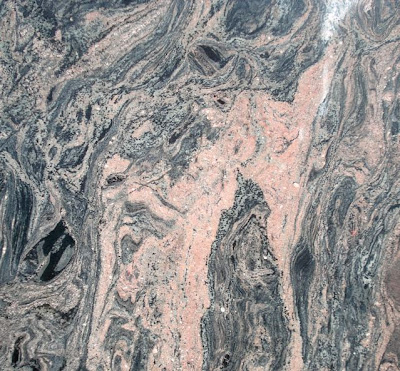
Up close with the Morton Gneiss

Geologists had long known that the Morton Gneiss was very old but not until 1956 when Samuel Goldich and three other geologists published a crystallization date of 2.4 billion years did geologists learn how old. Previously, geologists had simply used undated terms such as primitive, Huronian, and Archean. Seven years after Goldich’s discovery, Ed Catanzaro pushed the date back to 3.2 billion years, the oldest age so far determined on this continent. Not to be outdone, Goldich reanalyzed the Morton and came up with a date of 3.55 billion years. In November 1974, the rock became even older when Goldich reported the Morton was 3.8 billion years old, not just the oldest rocks on North America but the oldest rocks on Earth. As one can imagine there was much rejoicing.
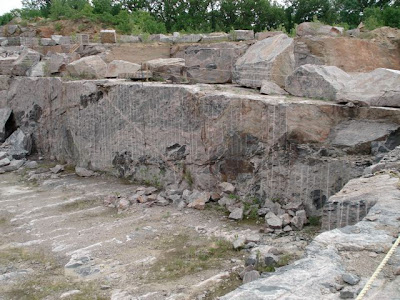
The Morton Gneiss Quarry, in Morton

Fame was fleeting though. By 1980, the age of the Morton had dropped back to 3.5 billion years. In 2006, Pat Bickford, emeritus professor of petrology at Syracuse University, led a team of researchers who obtained the Morton’s most up to date age of 3,524 million years. Although the Morton is but a babe compared to the oldest rocks on Earth, it is still the oldest, most commonly used building stone in the world. And, in my opinion, one of the best looking.

Poetry in Stone – Robinson Jeffers

Granite so infused the life of Robinson Jeffers that it helped transform him from a imitative, mediocre poet to one of the great American poets of the 20th century. His transformation occurred during the time he built his house, built on a barren knoll that jutted out into the Pacific Ocean in Carmel, California. Jeffers built what he and his wife called Tor House and the accompanying Hawk Tower between 1919 and 1925.

“My fingers had the art to make stone love stone,” wrote Jeffers in a poetic tribute to Tor House. His intimate knowledge of rocks came from the years he spent finding, carrying, and placing boulders for his exquisite little home. During the 44 years he lived at Tor House, Jeffers developed what Loren Eisely called “one of the most uncanny and complete relationships between a man and his natural background, that I know in literature.”

Looking toward the ocean from the garden at Tor House

I first saw Tor House and Hawk Tower in 2002 from the road that runs along the water below them. Light green grasses, gray-green shrubs and a few light gray boulders covered the slope leading up to the stone buildings. The house is squat with a narrow row of windows just below a small triangle of brown roof. The tower is square, about half the width of the house, and topped by a square turret with two eye-like windows opening out to the ocean behind me. The structures didn’t appear to be built so much as they appeared to emerge geologically from the hillside, as if Jeffers had used the nearby cliffs, seastacks, and outcroppings for blueprints.

Tor House and Hawk Tower

Up close, the buildings sustained my first impressions of geology manifest as home. No two stones were alike and rarely did stones of the same size rest next to each other. Edges were not perfectly straight but looked weathered and eroded. Barnacles still covered some of the stones Jeffers liberated from the sea. Finger trails ran through the mortar, trace fossils of a man and his passion.

Hawk Tower

His passion and intimacy with rock reveals itself in his poetry. I love his imagery of rocks as the “bones of the old mother” or the “world’s cradle.” Waves are “drunken quarrymen/Climbing the cliff, hewing out more stone for me.” The surf “cheerfully pounds the worn granite drum.” During erosion the “hills dissolve and are liquidated.”

And it is clear Jeffers felt the tremor of at least one earthquake. He wrote:

…the teeth of the fracture

Gnashed together, snapping on each other; the powers

of the earth drank

Their pang of unendurable release and the old resistances

Locked. The long coast was shaken like a leaf.

In a second, haunting description:

The heads of the high redwoods down the deep canyon

Rippled, instantly earthquake shook the granite-boned

ridge like a rat

In a dog’s teeth; the house danced and bobbled,

lightning flashed from the ground, the deep earth roared

yellow dust

Was seen rising in divers places and rock-slides

Roared in the gorges; then all things stilled and the

earth stood quiet.

Jeffers clearly paid attention to the natural world around him. Ever since his childhood he had had a connection to nature but not until he settled in Carmel and worked on the land did he develop the knowledge that gave him a voice to describe place. And this relationship centered on the house and tower he built from granite boulders on a low, barren knoll overlooking the sea.

“The place was maiden, no previous/Building, no neighbors, nothing but the elements, Rock, wind and sea,” wrote Jeffers in a poem titled The Last Conservative. How could he build any other type of structure? How could I not love that building? In his ode to Tor House, Jeffers concludes “My ghost you needn’t look for; it is probably here, but a dark one, deep in granite.”