Starbucks and Slate

Coffee and slate: two great things that go together. Yesterday, the Seattle Times reported that Starbucks is putting a new look into some of its stores. Primarily, the corporation is planning to use more recycled and reused building materials. What struck me most about the article is that the new menu boards at the remodeled stores in Seattle use chalkboards from Garfield High School. Those chalkboards, which I (along with previous Garfield attendees Quincy Jones, Jimi Hendrix, and Bruce Lee) may have used when I attended Garfield in the 1980s, are made of slate.

Starbucks’ remodeled store in Seattle (from the Seattle Times)

Blackboard slate came primarily from Lehigh and Northampton counties in Pennsylvania. The metamorphosed stone began as a sediment deposited in an ocean, when rivers carried clay, silt, and sand off North America and out into a deep marine basin. The 450-million-year old sediments first formed into shale, followed tens of millions of year later by metamorphosis to slate, under thousands of feet of rock. At present, up to 7,000 feet of slate beds make up the valleys and ridges around Pen Argyl, 60 miles north of Philadelphia.
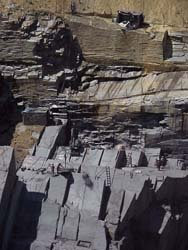
Pennsylvania slate (from Penn Big Bed Slate Co. Inc. web site)

Smooth, durable, and uniform, slate took chalk easily and legibly, didn’t absorb water, and stayed straight and true. By 1905, the majority of blackboard makers in the United States sold boards of slate. Six years later, the Cyclopedia of Education reported on blackboards that “It is doubtless no exaggeration to say that [slate]…should be used for all brick, stone, or concrete buildings.”

Blackboards are a wonderful teaching tool. They don’t break or warp. They can be cleaned indefinitely, either with an eraser or with your hand. They produce a pleasing click-clack sound when written on properly. Often taking up an entire side of a room, they provide a huge space for jotting down anything from music to drawings to numbers. They also seem eternal and permanent. Just think of the photographs of Einstein, or any number of mathematicians and physicists, writing out elaborate equations on a blackboard and you will recognize the role they have played in education and communication.

Or consider how our use of blackboards has seeded our language. We wipe the slate clean or start over with a clean slate. We chalk up something to experience. We refer to a tabula rasa, literally a scraped tablet, but more often defined as a clean slate. We vote for one of a slate of candidates. We are slated to do something and those who had a debt were formerly said to be on the slate. No other stone has contributed a comparable literary etymology.

I am happy to see the reuse of the slate from Garfield by Starbucks. I am lucky to have my own slab of that slate as well. The only downside is that Garfield now has those ugly, petroleum based whiteboards instead of the wonderful blackboards of my youth. Perhaps the school district can be inspired by Starbucks and reuse slate. It is certainly more environmentally hip than whiteboard.

America’s Building Stone – Chapter 6

Go to any city across the country and you will find one building stone in all of them: Salem Limestone from Indiana. People pray, have babies, get drivers licenses, and file for divorce in structures made from this 330-million-year old buff rock. Salem was also the first stone that many people encountered when they entered the United States; the administration building at Ellis Island was completed in 1900 with Salem Limestone trimming the red brick.

As with most building stones, use of Salem started locally with workers hauling blocks eight miles for the foundation and window sills of a county courthouse in 1819. The first quarry opened eight years later but little stone made it outside Indiana until the railroad reached Bedford and Bloomington in 1853.

The big break for Salem quarriers came in 1871 when Chicago burned to the ground. Within a few years, Indiana quarrymen had set up shop to promote their stone. One promoter wrote, “This purity insures absolute integrity on exposures to the fumes of coal, while the perfect elasticity and flexibility of the mass render it invulnerable to the forces of cold and heat, air and moisture.” Others claimed that the stone cleaned itself and that it had withstood the ice age “scarcely changed in any part.”

The Salem soon became the stone of Chicago. In 1889 William Vanderbilt ordered 25 carloads for a mansion on Fifth Avenue and his august imprimatur spurred others to follow. Within a decade Salem dominated markets in Philadelphia, New York City, Boston, Cincinnati, Kansas City, and Cedar Rapids.

Several aspects of Salem Limestone combined to make everyone from Odd Fellows to opera fans incorporate the stone in their structures. Stone masons can cut, plane, flute, and carve the Salem easily and in all directions and once shaped, Salem hardens over time. It splits evenly, and in any direction. When rock had to bear the weight of a building, Salem excelled because of its low compressibility. When stone became a skin hanging on a steel skeleton, Salem remained popular because of its ease in cutting.

Changes in architectural fashions also helped sell Salem Limestone. In the last quarter of the 19th century, architects turned away from the dark, somber stones, such as brownstone, that dominated cities in the eastern United States. Salem Limestone also benefited from the growth of coal-fired plants, because Salem stones did not disintegrate under attack by coal-generated pollution like other limestones. (As geologist David Dale Owen wrote in 1838, Salem Limestone “would imbibe less water.”) By 1928, the peak year of production, Indiana quarries provided 70% of all exterior building stone used in the United States.

Salem Limestone quarries are still active, shipping rock as far as Japan and Turkey. In the United States, Salem-clad buildings occur in all 50 states, and include 27 state capitols, 750 post offices, and 200-plus courthouses. It is the most commonly used building stone in the country.