Lyons and Lions in Seattle

One of the most unusual building stones in Seattle is the Lyons Sandstone. I know of only one building built with it. That building is now known as the Interurban but began life as the Seattle National Bank. The new name came about sometime after 1902 when the Tacoma Interurban railway terminated in front of the building. Running from Tacoma via Green Valley and with an off shoot to Renton, the Tacoma Interurban ran from 1902 to 1928.
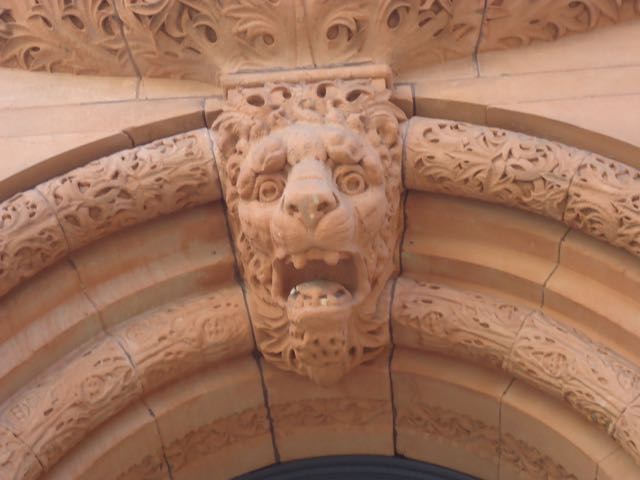
Lion of Lyons
Lion of Lyons

English-native John Parkinson designed the building in 1890-1892. He later moved to Los Angeles where he is much better known, especially for the Los Angeles Coliseum and City Hall. In Seattle, he also designed the Butler Block, sadly most of which was removed; the upper brick clad stories have now been replaced with a rather banal garage. At the least the handsome granite base remains.

The classic Romanesque Revival building is a delightful ediface. At the base is the local Chuckanut Sandstone, a gray sandstone. Sitting atop it is the Lyons Sandstone, quarried at the Kenmuir Quarry in Manitou Springs and shipped by rail to Seattle. I have not been able to determine why Parkinson chose the Lyons rock, though it clearly contrasts well with the Chuckanut and complements the brick that makes up the remaining part of the building. The Lyons was deposited as sand dunes during the Permian Period around 280 million years ago. Outcrops of the rock, which often appear as massive hogbacks, occur along the Front Range of Colorado, including such famous areas as Red Rocks Amphitheater and Garden of the Gods. Minute quantities of oxidized hematite (that is rusted) give the Lyons its red color.

Lyons Sandstone was the most commonly used sandstone building stone quarried in Colorado. Quarries opened in the 1870s and continued in Manitou until the 1910s, and still takes place in Lyons, where descendents own the quarries opened by their relatives in 1873.

Welcome In...pfffth.
Welcome In…pfffth.

What makes the Interurban particularly charming are the elaborate carvings. The most obvious is the lion overlooking the entrance at the corner of Occidental and Yesler. More intriguing figures are found in two additional locations. To the east on Yesler is another entrance, where you can find grotesques on the columns. (There is some debate about the origin of the term grotesque, but many trace it to paintings in Roman grottoes.) These curious faces were a commonly used architectural feature, often adding a sense to a whimsy to stately structures. Another grotesque peaks out from carved foliage on the southwestern side of the building. It’s about 20 feet above ground level.
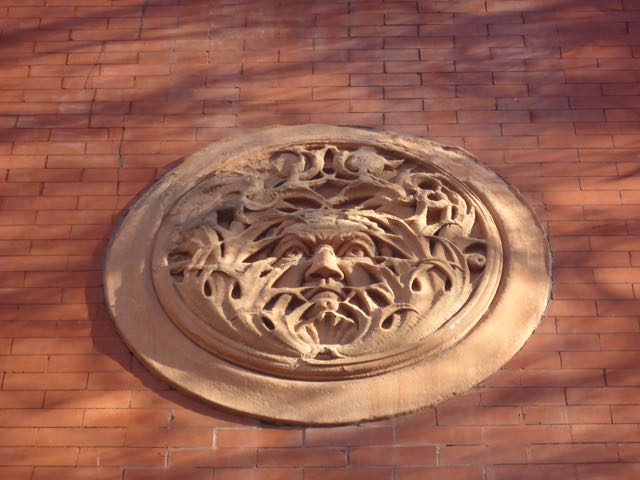
What you looking at?

These are not the only grotesques in Seattle. I know of one building that has 78 carved in its sandstone. Do you know it? There is also another curious feature on the Interurban. Do you know it?
 

Walrus Heads in Seattle

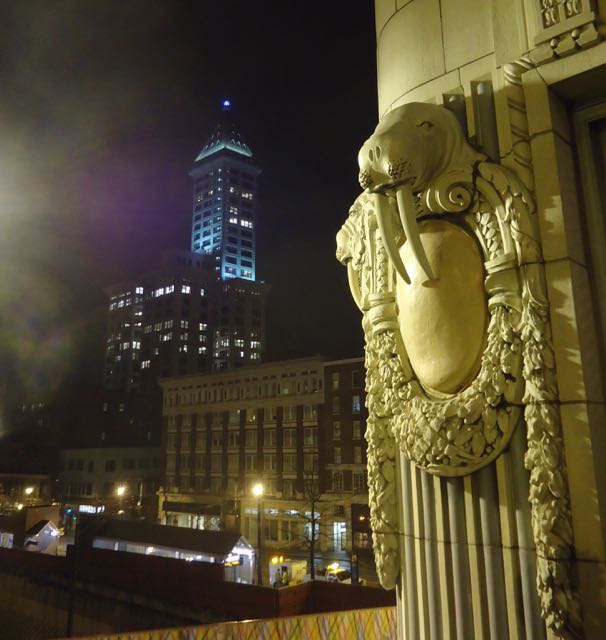
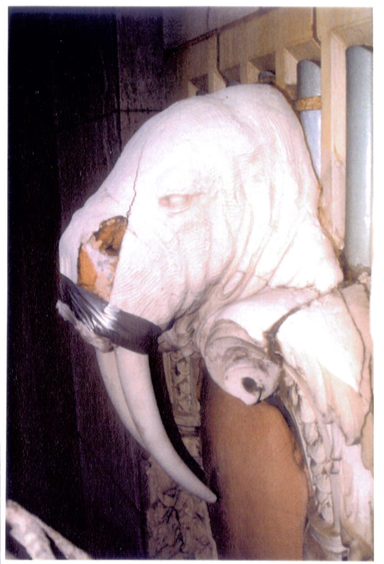
They are arguably the most famous heads in Seattle but unlike many others they say nothing. They only stare out wide-eyed in all of their tusked glory. They are, of course, the 27 terra cotta walrus heads on the Arctic Building at Third Avenue and Cherry Street. Designed by Augustus Warren Guild and opened in 1917, the building was originally the home of the Arctic Club, a Seattle-based social club.

Walrus at Night
Walrus at Night

The walruses have a storied history. Originally made by the Denny-Renton Clay & Coal Company, the heads consisted of three parts, two tusks and a head, all made from terra cotta. The tusks were held in place by steel rods and a sulfur-based bonding agent. Some have claimed that the original tusks were ivory or marble but this is wrong. There is also a rumor that one of the tusks fell out during Seattle’s 1949 earthquake. I have not been able to find any evidence that this happened but all of the tusks were supposedly removed following the quake.

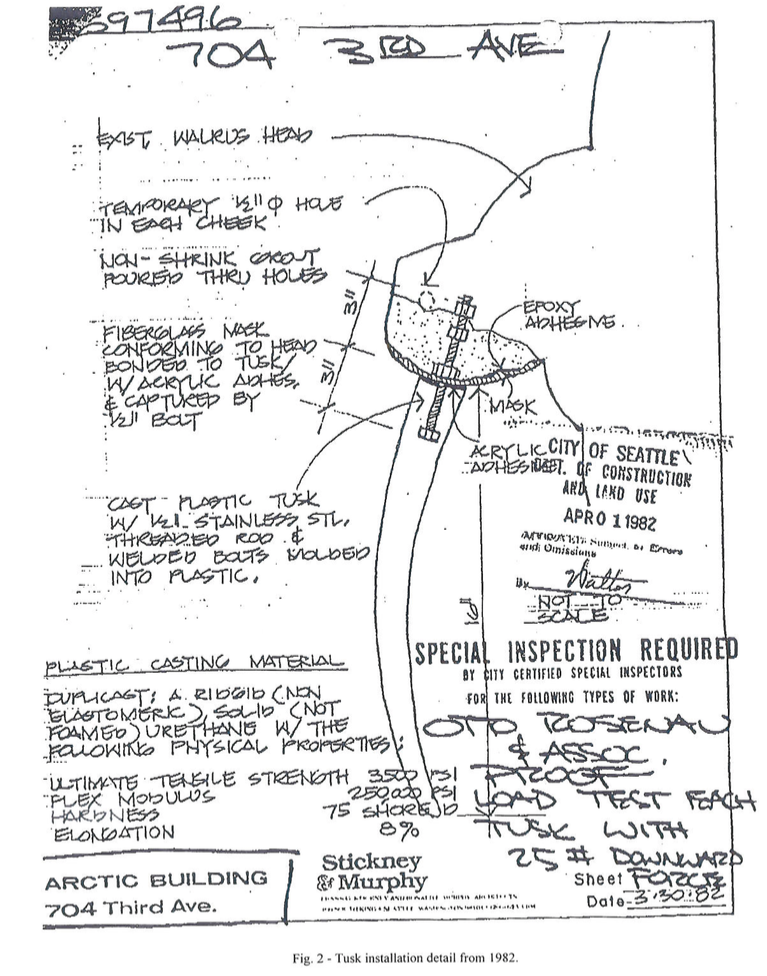
Finally, in 1982, the walruses got a little dental work with the installation of brand new tusks. They were made of molded urethane. Since they didn’t have the originals they had to create entirely new ones. One person involved in the project told me “We didn’t have any images so I went to the library to find photographs.” They were made by Architectural Reproductions, Inc., now Architectural Castings.

WJE Photo of Wounded Walrus

Embedded in each tusk was a threaded stainless steel rod, which extended about 3 inches beyond the tooth and was then inserted into the head into grout, or what I like to call snout grout. Within a year or two, cracks in the head appeared. They were repaired with epoxy and the repaired heads repainted.

More cracks appear in the 1990s. A study in 1996 by Wiss, Janney, Elstner Associates, Inc. (WJE) determined that the snout grout was responsible for the cracking. Apparently moisture had entered the heads and reacted with gypsum, which had then expanded in the confined space, as if the walruses had really bad head colds. This led to the replacement of 13 heads. Because no one in the area could make new heads out of terra cotta, the new ones came from Boston Valley Terra Cotta, in Orchard Park, NY. The other 14 were repaired. All of them contain the tusks made in 1982.

WJE Drawing
WJE Drawing

Before leaving the heads behind I want to make a somewhat off subject foray. According to that great font of word wisdom, the OED, the walrus was previously known as the morse. In addition, the word walrus has a challenging etymology, which was worked out by none other then J.R.R. Tolkien. I think that’s sort of cool, though the OED doesn’t offer up any information on what seems to be could be the plural of walrus, or walrusi. After all we have cactus and cacti. Why can’t we have walrus and walrusi? I am waiting to hear from my more Latin-knowledgeable pals.